4-hydroxybenzoic acid
Compound Overview
| Name | 4-hydroxybenzoic acid |
|---|---|
| IUPAC Name | 4-Hydroxybenzoic acid |
| Formula | C7H6O3 |
| SMILES | C1=CC(=CC=C1C(=O)O)O |
| Carbon Number | 7 |
| Molecular Weight | 138.12 |
| Polymer Type | monomer |
| Synonyms |
p-Hydroxybenzoic acid para-Hydroxybenzoic acid PHBA 4-Hydroxybenzoate p-Salicylic acid p-Carboxyphenol 4-Hydroxybenzoic acid |
Chemical Structure
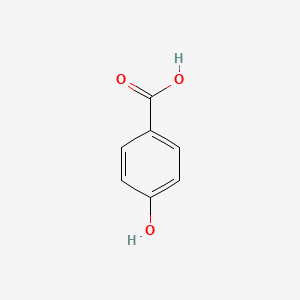
Structure from PubChem
External Databases
Empirical Data
Organisms that can utilize this substrate (69) Empirical
| Organism ▲ ▼ | Strain ▲ ▼ | Reference ▲ ▼ | Comment ▲ ▼ |
|---|---|---|---|
| Rhodococcus rhodochrous | 116 | Karlson et al (1993), Karlson et al (1993) | - |
| Cupriavidus pinatubonensis | 1245 | Sato et al (2006) | - |
| Fusarium oxysporum | 4287 | Michielse et al (2012) | - |
| Amycolatopsis sp. | 75iv2 (ATCC 39116) | Pometto III et al (1981), Sutherland et al (1983) | - |
| Streptomyces coelicolor | A3(2) M600 | Davis et al (2009) | - |
| Acinetobacter baylyi | ADP1 | Salvachúa et al (2015), Fischer et al (2008) | - |
| Pseudomonas fluorescens | AN103 | Paulsen et al (2005) | - |
| Paraburkholderia aromaticivorans | AR20-38 | Margesin et al (2021) | - |
| Trichosporon oleaginosus | ATCC 20509 | Yaguchi et al (2017) | - |
| Rhodococcus fascians | AY730713 | Song (2009) | - |
| Agrobacterium tumefaciens | B6 | Parke (1997) | - |
| Comamonas testosteroni | BR6020 | Providenti et al (2001) | - |
| Haloferax sp. | C-24 | Erdoğmuş et al (2013) | - |
| Halorubrum ezzemoulense | C-46 | Erdoğmuş et al (2013) | - |
| Serratia marcescens | C5 | Rhoads et al (1995) | - |
| Exophiala jeanselmei | CBS 658.76 | Middelhoven (1993) | - |
| Rhodotorula mucilaginosa | CBS17 | Sampaio (1999) | - |
| Trichosporon cutaneum | CBS2466 | Middelhoven (1993) | - |
| Candida parapsilosis | CBS604 | Middelhoven et al (1992), Gérecová et al (2015) | - |
| Rhodopseudomonas palustris | CGA001 | Harwood et al (1988) | - |
| Comamonas testosteroni | CNB-1 | Ni et al (2012) | - |
| Thauera sp. | Cin3,4 | Mechichi et al (2005) | - |
| Haloarcula sp. | D1 | Fairley et al (2002) | - |
| Rhodosporidiobolus colostri | DBVPG 10655 | Margesin et al (2022) | - |
| Rhodococcus opacus | DSM 1069 | Kosa et al (2011) | - |
| Pseudomonas fluorescens | DSM 50090 | Ravi et al (2018) | - |
| Acinetobacter calcoaceticus | DSM 586 | Delneri et al (1995) | - |
| Sphingomonas aromaticivorans | F199 | Cecil et al (2018) | - |
| Leucosporidium scottii | G43 | Middelhoven (1993) | - |
| Rhodosporidium toruloides | IFO0880 | Yaegashi et al (2017) | - |
| Pseudomonas sp. | Isolate 9.1 | Ravi et al (2018) | - |
| Oceanimonas doudoroffii | JCM21046T | Numata et al (2015) | - |
| Paenibacillus sp. | JJ-1b | Crawford et al (1979) | - |
| Cupriavidus necator | JMP134 | Salvachúa et al (2015), Pérez-Pantoja et al (2008) | - |
| Thauera aromatica | K172 | Tschech et al (1987), Tschech et al (1987) |
(anaerobically) (anaerobically) |
| Bacillus licheniformis | KB1 | Kuhnigk et al (1997) | - |
| Alcaligenes faecalis | KD10 | Kuhnigk et al (1997) | - |
| Bacillus cereus | KD4 | Kuhnigk et al (1997) | - |
| Bacillus sphaericus | KD7 | Kuhnigk et al (1997) | - |
| Bacillus subtilis | KD8 | Kuhnigk et al (1997) | - |
| Burkholderia cepacia | KF12 | Kuhnigk et al (1997) | - |
| Pseudomonas citronellolis | KMA4 | Kuhnigk et al (1997) | - |
| Acinetobacter baumannii | KMB1 | Kuhnigk et al (1997) | - |
| Pseudomonas aeruginosa | KMD3 | Kuhnigk et al (1997) | - |
| Comamonas acidovorans | KNB3 | Kuhnigk et al (1997) | - |
| Pseudomonas putida | KT2440 | Salvachúa et al (2015), Ravi et al (2017) | - |
| Marinobacterium georgiense | KW-40 | GONZaLEZ et al (1997) | - |
| Aeromonas sp. | L17 | Deschamps et al (1980) | - |
| Enterobacter aerogenes | L7 | Deschamps et al (1980) | - |
| Pandoraea norimbergensis | LD001 | Bandounas et al (2011) | - |
| Azoarcus anaerobius | LuFRes1 | Gorny et al (1992) | (anaerobically) |
| Klebsiella pneumoniae | M5a1 | Jones et al (1990) | - |
| Candida orthopsilosis | MCO457 | Gérecová et al (2015) | - |
| Acetobacterium woodii | NZva16 | Bache et al (1981) | (anaerobically) |
| Desulfobacterium catecholicum | NZva20 | Szewzyk et al (1987) | (anaerobically) |
| Rhodococcus opacus | PD630 (DSMZ 44193) | Henson et al (2018) | - |
| Pseudomonas putida | PRS2000 | Ornston et al (1976) | - |
| Pseudomonas putida | Perestelo isolate 3 | Perestelo et al (1996) | - |
| Desulfobacterium phenolicum | Ph01 | Bak et al (1986), Bak et al (1986) |
(anaerobically) (anaerobically) |
| Rhodococcus jostii | RHA1 | Salvachúa et al (2015) | - |
| Sphingobium sp. | SYK-6 | Katayama et al (1988) | - |
| Burkholderia cepacia | Song isolate 1 | Song (2009) | - |
| Pantoea dispersa | Song isolate 2 | Song (2009) | - |
| Rhodococcus fascians | Song isolate 3 | Song (2009) | - |
| Flavimonas oryzihabitans | Song isolate 4 | Song (2009) | - |
| Microbacterium esteraromaticum | Song isolate 5 | Song (2009) | - |
| Rhodococcus erythropolis | TA421 | Chung et al (1994) | - |
| Streptomyces sp. | ZC2 | Kuhnigk et al (1997) | - |
| Sulfuritalea hydrogenivorans | sk43H | Sperfeld et al (2018) | (anaerobically) |
Pathways Empirical
| Pathway Name | Full Name |
|---|---|
| p-coumaric acid | p-coumaric acid |
Predicted Relationships
Hide predicted
The sections below contain relationships inferred from the empirical data above. They are computationally predicted and have not been independently verified. Learn more about data assumptions →
Organisms predicted to process 4-hydroxybenzoic acid through a pathway Predicted
For each pathway where 4-hydroxybenzoic acid enters as a reactant, organisms recorded as being able to utilise it but not yet confirmed for that pathway are listed as predicted. Not experimentally verified. What does this mean?
Reactions involving 4-hydroxybenzoic acid
| Reaction | Role in Reaction |
|---|---|
| 4-hydroxybenzoic acid + NADPH + oxygen + H+ → protocatechuic acid + NADP+ + H2O | substrate |
| 4-hydroxybenzaldehyde + NADP+ + H2O → 4-hydroxybenzoic acid + NADPH + 2 H+ | product |