coniferyl alcohol
Compound Overview
| Name | coniferyl alcohol |
|---|---|
| IUPAC Name | 4-[(1E)-3-hydroxyprop-1-en-1-yl]-2-methoxyphenol |
| Formula | C10H12O3 |
| SMILES | COC1=C(C=CC(=C1)C=CCO)O |
| Carbon Number | 10 |
| Molecular Weight | 180.2 |
| Polymer Type | monomer |
| Synonyms |
Coniferol trans-Coniferyl alcohol 4-(3-hydroxy-1-propenyl)-2-methoxyphenol 4-[(1E)-3-hydroxyprop-1-en-1-yl]-2-methoxyphenol |
Chemical Structure
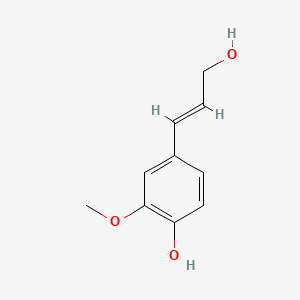
Structure from PubChem
External Databases
Empirical Data
Organisms that can utilize this substrate (4) Empirical
| Organism ▲ ▼ | Strain ▲ ▼ | Reference ▲ ▼ | Comment ▲ ▼ |
|---|---|---|---|
| Serratia marcescens | C5 | Rhoads et al (1995) | - |
| Rhodococcus opacus | DSM 1069 | Kosa et al (2011), Eggeling et al (1980) | - |
| Pseudomonas sp. | HR199 | Overhage et al (1999) | - |
| Pseudomonas putida | KT2440 | Jiménez et al (2002) | - |
Pathways Empirical
| Pathway Name | Full Name |
|---|---|
| coniferyl alcohol | coniferyl alcohol |
Predicted Relationships
Hide predicted
The sections below contain relationships inferred from the empirical data above. They are computationally predicted and have not been independently verified. Learn more about data assumptions →
Organisms predicted to process coniferyl alcohol through a pathway Predicted
For each pathway where coniferyl alcohol enters as a reactant, organisms recorded as being able to utilise it but not yet confirmed for that pathway are listed as predicted. Not experimentally verified. What does this mean?
| Organism | Strain | Inferred via pathway | Reference confirming coniferyl alcohol utilization |
|---|---|---|---|
| Pseudomonas sp. | HR199 | coniferyl alcohol | Overhage et al (1999) |
| Rhodococcus opacus | DSM 1069 | coniferyl alcohol | Kosa et al (2011), Eggeling et al (1980) |
| Serratia marcescens | C5 | coniferyl alcohol | Rhoads et al (1995) |
Reactions involving coniferyl alcohol
| Reaction | Role in Reaction |
|---|---|
| Coniferyl alcohol + NADP+ → coniferyl aldehyde + NADPH +H+ | substrate |
Transporters
No transporters are currently linked to this substrate.